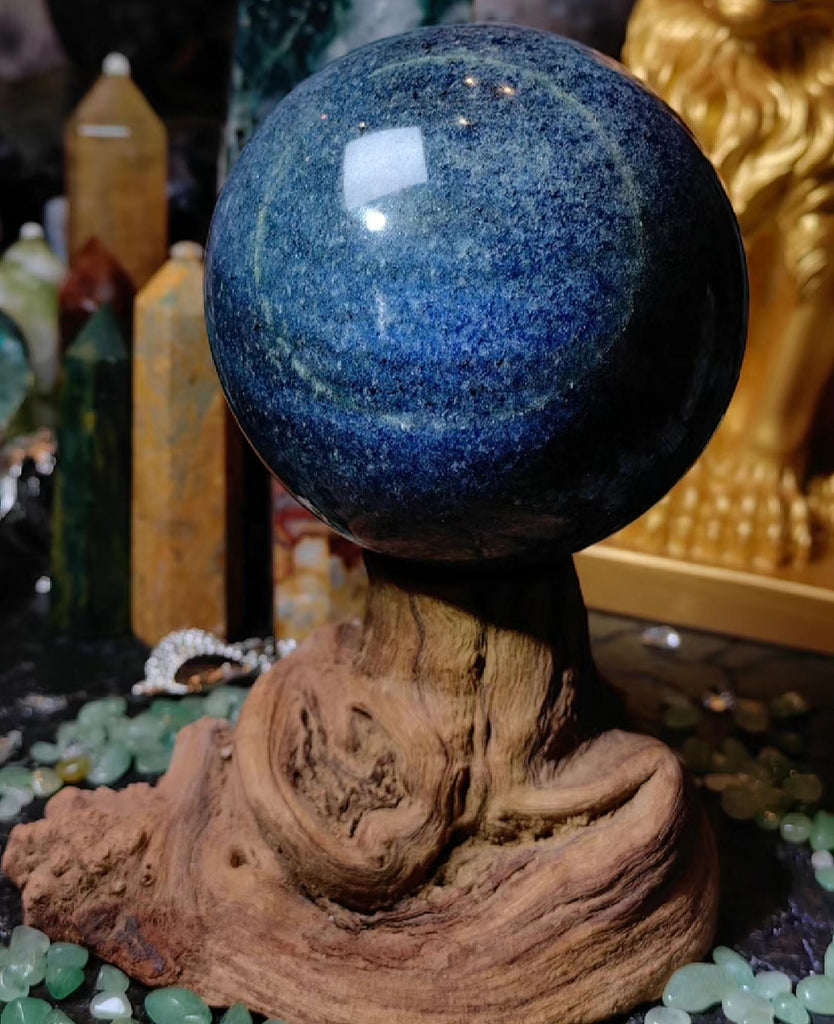
Blue Goldstone is loved for its deep midnight-blue colour and dense star-like sparkle, but one fact should always be clear: Blue Goldstone is a man-made glass material, not a naturally occurring crystal or gemstone.
Its shimmering appearance comes from tiny metallic copper crystals or particles formed within the glass during manufacture. Under direct light, the reflective inclusions create the familiar night-sky effect.
Why is it called Goldstone if it is blue?
Goldstone refers to the family of sparkling glass materials rather than a naturally mined mineral. Different formulations produce different colours, including brown-gold, blue and green varieties. Blue Goldstone typically has a dark cobalt-blue glass body filled with warm metallic sparkle.
Is Blue Goldstone fake?
It should not be described as a natural stone, but that does not make it a bad material. It is decorative glass made deliberately for its colour and sparkle. The important issue is accurate disclosure: buyers should know what they are purchasing.
Moon Rituals identifies our Blue Goldstone products as man-made glass so customers can choose them for their appearance without being misled about origin.
How to choose Blue Goldstone
Sparkle density: look for even metallic sparkle across the visible surface.
Colour: a deep blue base gives the strongest contrast with the coppery reflections.
Shape: spheres create a galaxy-like effect as you rotate them; towers suit shelves and desks; double-terminated points are compact and work well in small displays or grids.
Finish: polished surfaces should feel smooth and allow the metallic inclusions to show clearly.
A good current option
Our Blue Goldstone Double-Terminated Point is approximately 4–5cm and is currently available. Its small size makes it easy to add to a desk, shelf, gift set or mixed crystal display.
Traditional symbolism
Modern metaphysical communities often associate Blue Goldstone with ambition, confidence, creativity and reaching for goals, partly because its star-like appearance naturally lends itself to that symbolism. These are personal and spiritual associations rather than scientifically established effects.
Blue Goldstone vs natural blue crystals
If natural mineral origin matters to you, consider stones such as Lapis Lazuli, Sodalite, Blue Calcite or blue-toned Fluorite instead. If your priority is intense sparkle and a consistent midnight-blue appearance, Blue Goldstone offers a look that natural stones rarely reproduce.
Care
Because Blue Goldstone is glass, protect it from hard impacts and sudden temperature changes. Clean it with a soft damp cloth and dry it afterward. Store it separately from harder stones that may scratch the polished surface.